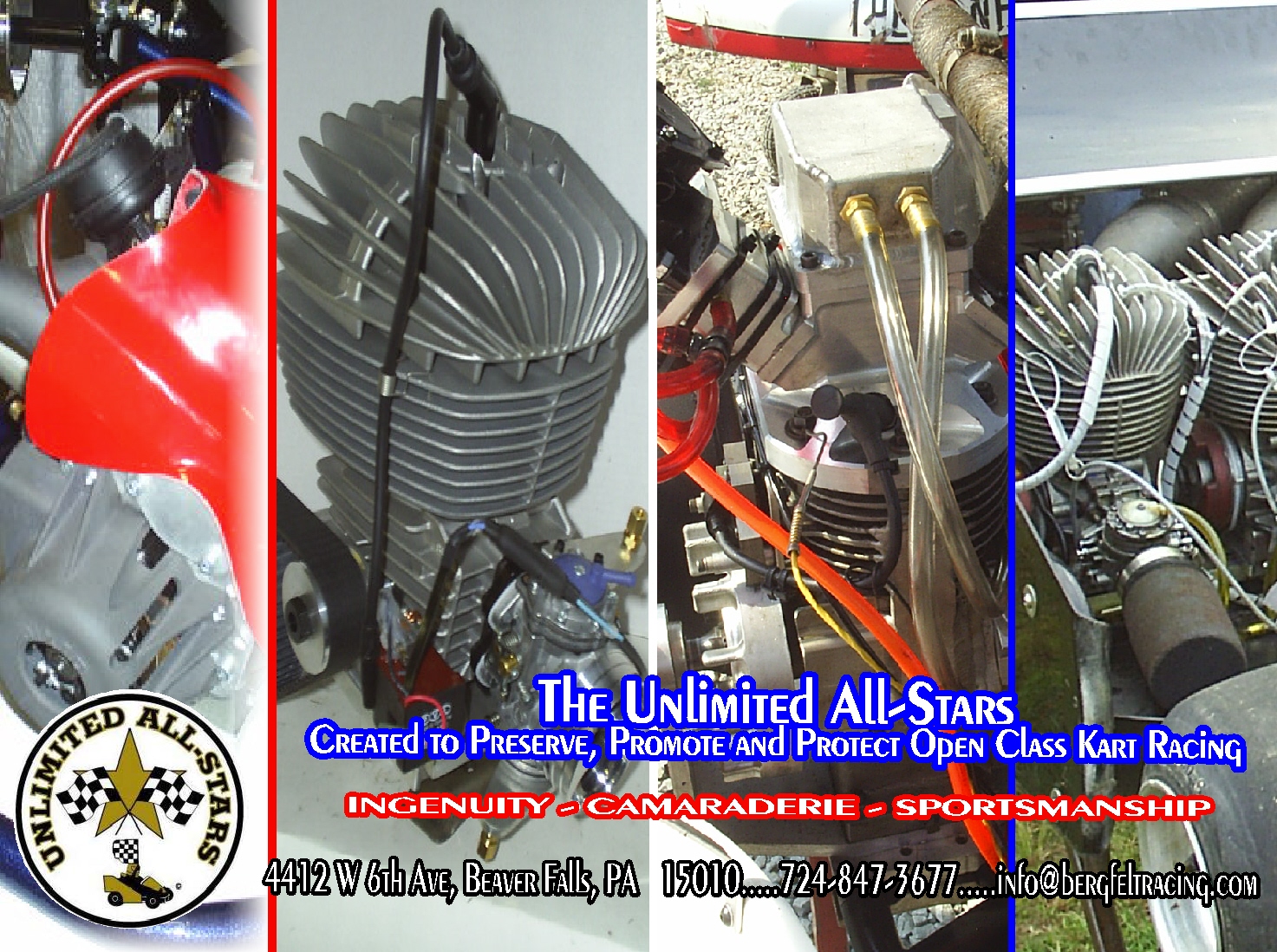
2008 Unlimited All-Stars Rules
Please note; Items in blue type have been changed from the 2007 rules.
1. Engines
A. Any type two-stroke cycle engine or engines, no limit to modifications.
B. Any type four-stroke cycle engine or engines, no limit to modifications.
C. Rotary engines are presently being studied and tested for future inclusion.
2. Minimum Weight / Maximum Displacement
A. Rotary valve or Reed valve Two-Stroke Cycle Engine or Engines, 230 lbs plus one pound for each cc or fraction of a cc. Multiple engines or cylinders are permissible. 210 cc maximum total displacement.
B. Flat Head Four-Stroke Cycle Engine or Engines, 190 lbs plus one pound for every 3cc or fraction of a cc. multiple engines or cylinders are permissible. 466 cc maximum total displacement.
C. Piston Port, McCulloch or US820 (West Bend) Two-Stroke Cycle Engine or engines, 170 pounds plus one pound for every cc or fraction of a cc. Multiple engines or cylinders are permissible. 225 cc maximum total displacement.
D. Overhead Cam (OHC) Four-Stroke Cycle Engine or Engines, 245 lbs plus one pound for every 2 cc or fraction of a cc. Multiple engines or cylinders are permissible, 265cc maximum total displacement.
E. Overhead Valve Push Rod (OHV) Four-Stroke Cycle Engine or Engines, 220 lbs plus one pound for every 2.5cc or fraction of a cc. Multiple engines or cylinders are permissible, 446cc maximum total displacement.
F. Rotary (Wankel) engines produced for the kart racing market, 380 llbs kart and driver combined minimum weight, (this is subject to review at the end of the season)
.
F. Forced Induction and Nitrous Oxide. If a kart is equipped with some type of supercharger turbocharger, or nitrous oxide system, add 15 lbs for each cylinder that is served by the system.
G. Mixed Engine Type in Multiple Engine Situations. The minimum weight for the engine corresponding with the higher weight will be imposed.
H. Fuel. There are no fuel restrictions except that no illegal substance or substances may be used as fuel or as a fuel additive.
3. Calculating Displacement / Declaring Weight
A. The bore will be measured with dial calipers and the stroke with a two or three inch travel dial indicator.
B. The following formula will be used for calculating displacement;
BORE X BORE X STROKE X .7854 X 16.39 = CC of engine.
(This assumes that the bore and stroke were measured in inches. The 16.39 is a conversion factor from cubic inches to cubic centimeters.)
C. Always round up to the nearest whole cc when calculating minimum weight.
D. Competitors must declare their weight and display it next to their front number in such a manner that the scale person can easily see it.
4. General Event Related Policies
A. The driver is the official entry. He / She can switch karts between heats or before the feature, but not during a race. The kart must comply with the minimum weight for that particular kart and display the number with which the driver registered.
B. All host track rules and regulations will be adhered to by drivers in the Unlimited All-Stars. The show will be run according to their normal procedures unless the promoter decides to modify those procedures to improve the event.
C. The promoter has the right to refuse any equipment for competition on his track that he feels is unsafe for competition.
D. The promoter is solely responsible for running the show. The Unlimited All-Stars will provide competitors and post-race technical inspection.
E. The promoter is to provide documents that list the feature race final finish, the heat winners, and those competitors who were in any consolation races. This information is necessary for calculation of points and event write-ups and is to be supplied to the regional administrator.
F. It is requested that promoters only permit a driver to spin out two times per heat race or feature race. Those drivers should be black flagged upon their third spin out.
G. It is requested that after two unsuccessful attempts at a double file start the field is to be lined up single file for remaining starts for that heat or feature race.
H. It is requested that drivers whose actions are cause for a caution on the initial start will be sent to the tail for remaining attempts at starting the race regardless of their initial starting position.
I. A UAS series held at a single track will be called a UAS Regional Series. A UAS series that takes place on multiple tracks will be referred to as a UAS Regional Circuit.
J. Special Events (UAS National Events)
From time to time a race track may choose to promote an event that is not a point race with-in a particular region. The event may be called an Unlimited All-Stars National if the promoter;
i. agrees to all of the rules and policies of the Unlimited All-Stars.
ii. Schedules the event at such a time as to not compete with any other UAS National Event or Regional Event.
iv. The date of the event must be released by November 30 of the previous year. This will allow local circuits/series to schedule around those dates.
v. No local circuit/series is to release their local schedule prior to
November 30. This will allow then to may build their schedule around the National Events.
vi. no regional circuit/series will hold an official point race on the same date
as a scheduled National Event and one weekend prior.
5. Safety Guidelines
A. Driving Gear. All drivers are to wear as a minimum;
i. A jacket or driving suit designed for kart racing. If the driver opts to wear a jacket he must wear heavy weight full length pants.
ii.. A full face, solid shell (no flip up type) Snell 2000 or newer helmet equipped with a flip up type face shield.
iii. Drivers must wear shoes that completely cover his/her feet.
iv. Drivers must wear gloves
.
v. Drivers must wear a neck collar/helmet support designed for kart and/or auto racing.
vi. Sportsman UAS drivers must wear a chest protection device that meet SFI standards
B. Karts
This program is intended for vehicles classified as go-karts. The go-karts are to be constructed in a safe manner. Maximum overall dimensions will be determined by the least restrictive parameters for any division as generally set forth by IKF, WKA, KART and CIK.
i. Chassis are to be constructed from steel tubing that is suitable for safe operation in high horsepower competition applications. Karts are to be what are known as “flat karts” meaning that they are not to have roll cages or bars positioned over the head of the driver. Chassis are to be solid meaning that they are not to be equipped with leaf or coil springs and shock absorbers that act as an active suspension device. Particular attention is to be made to the integrity of joints and welds.
ii. Steering. All fasteners used in the steering system must have some sort of device to prevent them from coming loose. Such devices may include but are not limited too; cotter keys (pins), safety wire, double nut, snap ring or clip. A single lock nut or nut with a lock washer is not acceptable by itself.
iii. Brake System. In general, the brake system utilized on a UAS kart must compliment the engine(s) that are used on the kart. It must be capable of locking the rear axle in the event that the throttle was to stick open. The brake requirements will vary depending on the power source. All UAS karts MUST meet the following minimum criteria;
a. Under no circumstances are stock Mini-Lite type brakes to be used. The calipers may be used in single cylinder engine situations with a suitable upgraded rotor.
b. All brake rotors must be made from steel or cast iron, be THICKER than 1/8” and have some sort of venting.
c. Multiple rotors and calipers or calipers with more than two pistons are highly recommended and are necessary on karts with more than one engine cylinder.
d. A steel plate, at least 3/32” thick must be placed between the brake rotor and seat to prevent the brake rotor from cutting through the seat in the event that the seat was to come loose.
e. Braided steel reinforced brake lines are recommended.
f. All fasteners used in the brake system must have some sort of device to prevent them from coming loose. Such devices may include but are not limited too; cotter keys (pins), safety wire, double nut, snap ring or clip. A single lock nut or nut with a lock washer is not acceptable by itself.
iv. Body Work and Dimensions
a. The IKF speedway rules for body work have been adopted by the Unlimited All-Stars as a general guideline for construction methods, materials and safety measures. An exception is that the maximum height is 30 inches instead of 26 and the overall length and width are determinedin the next clause.
b. No portion of a kart may stick out or protrude in such a way as to get caught on another kart or create a hazard in the event of contact between the karts.
c. All body work, fairings, wings spoilers, etc. must be located in such a manner that it will not trap the driver in the kart in the case of a mishap.
Clarification of UAS Body Work Policy
When body rules first became a consideration of the UAS rules it was solely for the purpose of safety. Since the IKF had the most permissive rules that were accepted by insurance companies, those rules were adopted as guidelines for safe construction. The UAS parts company with the IKF in regards to regulating the level of performance.
To summarize the most important points of the bodywork guidelines;
1. Generally speaking the highest portion of the kart body side panels are no more than 30” from the ground at the rear axle. The body panels may extend rearward no further than the rear bumper. The body panels should fall under an imaginary line drawn from 30 inches above the rear axle to the center of the front axle. It should be noted that some variation from this line is permissible as long as it does not block the vision of the driver, and that is the most important consideration of this guideline.
2. Body skin may not be made from any type of sheet metal or material known to be prone to shattering. Sharp edges are not permitted no matter what material is used for body work.
3. Nose pieces, front wings, fairings are to be designed in such a way that they do not block the driver’s vision or trap the driver in the kart in the case of a mishap, or create a hazard for other drivers.
4. Attention is to be paid to the leading edges of the nose piece and sides to insure that no part sticks out in such a way that it can get easily get caught on another competitors kart.
5. Support posts, spars, braces, etc. are to be made and attached in such a way that they can not puncture a driver in the case of impact with another kart.
6. The race track promoter has the final say regarding the body work that he permits on his/her race track.
6. Sponsorship
A. No sponsorship will be accepted if, any condition of accepting said sponsorship requires all competitors to use any particular brand of product or the modification of any rule.
B. Contingency sponsorships will be permitted. Example; XYZ company awards Joe Kart Racer $100 if he wins using his product and is displaying the sponsor’s sticker.
6. Rule / Policy Changes
A. No rule changes will be made during the course of a racing season.
B. The Series Administrator of a region is that person who has taken it upon him/herself to organize an Unlimited All-Stars circuit or series. He/she will serve as the spokesman and representative of that region. This position is very important for the success of a region. The Series Administrator should be independent from any particular race track or series.
C. All Rule changes, made for the next racing season, will only be made after a simple majority vote of all Voting Series/Circuit administrators.
D. A Voting Series Administrator is a series administrator that has coordinated a series or circuit for at least one season. This provides the perspective of first hand experience with the rules before being allowed to vote on potential rule changes.
E. A Non-Voting Series Administrator is a series administrator who is planning or implementing their first season with the Unlimited All-Stars.
7. Driver Eligibility
A. Drivers must be at least 18 years old. For 2008, those drivers who raced in the Sportsman UAS in 2007 or drivers who were given an age waiver to race in regional UAS races in 2007 are permitted to compete in the UAS in 2008.
B. Drivers must register with their local office of the Unlimited All-Stars, read these rules and policies, and sign a document stating that he/she has read the same and will comply with these regulations.
C. Series administrators will have a supply of the rules, and registration applications available at each event for the purpose of registering drivers at the local level.
D. Drivers who blatantly do not comply with these rules and policies are subject to suspension from all UAS events, in all regions, during the time of suspension.
E. The regional administrator who suspends a driver is to e-mail all of the other regional administrators informing them of whom the suspended driver is and the length of the suspension.
F.All regional administrators are to enforce the suspension.
G This provision is only to be used as a last resort. The most likely remedy for infractions is disqualification from the event by the event promoter.
H. Membership: Here's a simplified plan to implement the UAS National Membership:
1. Each UAS Regional Series or Circuit will decide
for themselves if they require ALL competitors at their
events to be UAS Members. Although UAS membership is
encouraged, it's up to the Regional Administrator
and their racers to decide what works best for their
Series or Circuit.
2. Only UAS members will receive points toward the
National Ranking for their finishing positions in both
Regional and National events. UAS members will receive
points based on their actual finishing position regardless of non-members finishing ahead of them.
For example: If a UAS Regional Circuit or Series
allows both members and non-members to compete and the
first UAS member competitor finishes third behind two
non-members, the UAS member only gets scored for his/her third place finish, because that's where he/she actually finished in the race.
3. UAS Regions hosting UAS National events will decide if UAS membership is required for that event the host Region will post that requirement with every announcement / promotion of the event.
What is the UAS Membership and what does it do for UAS competitors?
The UAS Membership is a plan to enable UAS competitors to compete across the country with parity among the different regions. UAS members competing in Official UAS series across the country can accumulate points toward the National Ranking System whereby there
will be a UAS driver Ranked #1, a single national champion, crowned at the end of the season.
UAS Membership annual dues are $25. UAS Competitors may join by contacting the administrator of their home region or any regional administrator. New members will pay their membership dues to their regional administrator.
UAS Members in good standing will be eligible to compete in any official UAS Regional or National event.
UAS Membership dues are split between the home region and the National UAS Organization. These dues are used to help provide funds for the
member’s home regional awards and the National Championship
awards. A small portion of the dues helps defray the
administrative costs of the Regional and National Administration.
Membership acceptance will be provided by the Regional
Administrator signing off on the prospective member's
application. Regional Administrators may hold the
application for the prospective member’s first race
to see how the competitor handles UAS competition.
Regional Administrators will monitor and handle any competitor
driving / sportsmanship issues as usual, regardless of
a competitor's membership status.
2. UAS membership is not retroactive. Membership
begins when dues are paid and membership application
is accepted by a Regional Administrator. National
rankings points’ accumulation starts at the
completion of the first race after dues are paid. No points
will be awarded for race finishes before dues are paid.
9. Point Calculation for Regional Series/Circuits
A. Points will be awarded to the various finishing positions of the Feature (or A- Feature or A- Main) as follows;
1-100, 2-98, 3- 96, 4-94, 5-92, 6-90, 7-88, 8-86, 9-84, 10-82, 11-80, 12-78, 13-76, 14-74, 15-72, 16-70, 17-68, 18-66, 19-64, 20-62, 21-60, 22-58, 23-56, 24-54, 25-52, and etc.
B-main drivers who do not transfer to the A-feature will ALL receive two points less than the last place finisher in the A-Feature.
C-main drivers who do not transfer to the B-feature will ALL receive 4 points less that the last place finisher in the B-Feature and etc
.
B. The driver who has earned the pole starting position for the feature will receive one additional point.
C. Drivers who are black-flagged for un-sports-man-like or hazardous driving infractions will receive no season points for that heat or feature.
D. Drivers who are disqualified at the scales will receive no points for that heat or feature.
E. Drivers who are disqualified in post race technical inspection will receive no points for the entire event.
F. Drivers who are black-flagged for spinning out will receive points as though they did not finish that particular race.
G. Decisions of the Track Promoter or his designated personnel and/or the Race Director will be final.
H. Approximately 80% of the races will count for season points for a particular region for a particular driver. The Series/Circuit Administrator will decide on the exact number and state that in their local options section.
I. Every rain-out or cancellation that is not rescheduled will result in one less event being counted for a driver’s final points.
J. Rain dates, if a region is to provide for them, are to be placed into the original schedule of the region, prior to the beginning of that regions season. If the make- up dates is not listed at the beginning of the season, the event may be held but it will not count for points for that region. The reason that this is important is to allow competitors to schedule their race schedules around their work and family obligations with minimal interruption.
Note to Competitors
The Unlimited All-Stars is intended to be a gentlemen’s series and all drivers and crew members are expected to act accordingly. If you can’t or won’t drive and act in a professional manner, then race in another division. We don’t necessarily want the most drivers, but we do want the best. Please give your competitors room to race. Respect the other drivers; they have a lot invested too. Rough driving, foul language, and unsportsmanlike conduct are not appreciated. Officials are requested to be especially firm with the Unlimited All-Stars. Remember, a lot of kids look up to YOU.
Spirit and Intent
The Unlimited All-Stars was created to preserve and promote open class kart racing. Innovation is allowed and encouraged. These rules were created to provide parameters for the purpose of safety, and consistency from track to track and region to region. Generally speaking, if a rule does not specifically state that something is not permitted, then it can be assumed that it is permitted. Series administrators are personally involved with the series/circuit in their region and will monitor the effect of new technology as it is created. Any rule adjustments that become necessary to maintain a level playing field due to the introduction of new technology will go into effect the following year.
Disclaimer
Bergfelt Racing Enterprises, LLC (BRE) and all other sponsors of the Unlimited All-Stars receive no financial considerations for monies from the events in this circuit/series. Their sole purpose is to publicize the races and recognize the participants and they (BRE and other sponsors) are in no way responsible for the operation or organization of the racing activities at any of the tracks that host an Unlimited All-Stars event. Competitors must realize that kart racing is a dangerous activity and they are to assume all risks to themselves and their property.
Use of Official Rules Logo
The official rules and logo of the Unlimited All-Stars are the copyrighted property of Bergfelt Racing Enterprises, LLC. The logo may only be used for the promotion of Official Unlimited All-Stars events and Series/Circuits on flyers, schedules and web pages. Use of the logo for any other purpose, without written permission is prohibited.
In instances where the rules are to be included as part of a web site, it is only permissible to link directly to; http://www.unlimitedallstars.com/rules.html. Any local option policies are to be included on each individual circuit/series website that applies to that circuit/series. Local options are to be kept to an absolute minimum and are only for the purpose of dealing with unique local issues.
Clubs and tracks that wish to use these rules for their unlimited/open class may, and are encouraged do so, but they are not allowed to cut and paste these rules into their rule book. Instead, they must refer their competitors to the web pages listed in the preceding paragraph. Clubs and individuals may print out, copy and distribute those web pages, but only in their entirety. It is forbidden to add anything to, or delete anything from the print-out or reproduced pages.
Sportsman Unlimited All-Stars
Purpose
The Sportsman All-Stars class was created to provide a training ground for experienced young drivers to prepare to compete in the Unlimited All Stars “senior” division. This class is intended for experienced drivers that demonstrate maturity and sportsmanship toward their fellow competitors. The engine rules have been formulated in such a way as to allow creativity within set parameters. Those parameters were chosen to allow the Sportsman All-Stars karts to handle in a manner similar to the more powerful and heavier “senior” class karts, but at a somewhat slower speed.
General Policies
The Sportsman All-Stars class is for drivers who are between 13 and 17 years old. Drivers turning 18 during the year may stay through the season’s end. Those competitors who entered at least one Sportsman All-Stars race in 2007 shall be “grandfathered” into the new age requirements.
Drivers must first demonstrate the ability to drive a Sportsman All-Stars kart in a suitable manner before being allowed to compete in a Sportsman All-Stars event. Drivers are encouraged to race in some other division for at least one season before entering a Sportsman All-Stars event.
The Sportsman All-Stars drivers are expected to race and conduct themselves in the same sportsmanlike manner that is expected of their senior driver counterparts. Contact during racing is to be avoided at all costs.
Under no circumstances will Sportsman All-Stars drivers compete on the track at the same time as the UAS “senior” division drivers.
Engines and Weights
Carburetion
Any carburetor is allowed so long as the venturi bore is circular and no greater than .650” OR a restrictor plate is in place that is circular and no greater than .650”. A .650” “no-go” will be used to tech the carburetor venturi or restrictor plate. The restrictor plate, if used, must be made from aluminum stock between 1/16” and 1/8” thick. Gaskets must be used on both sides of the plate that seal. No creative leakage will be tolerated. All fuel and air must pass through the plate, if used. No “atomizer rings” allowed in carburetor, although a carburetor’s venturi may be “sleeved” down in size to the “no-go” specification, the use of an “atomizer ring” is not allowed.
Normally Aspirated
Sportsman All-Stars engines may not be supercharged in any manner nor may they be fitted with nitrous oxide or any other power-enhancing device.
Modifications Allowed
Sportsman All-Stars engines may be internally or externally modified in any way. There is no tech or rules for the engine other than the carburetor/plate, weight Vs cc’s, flywheel and max cc rules. All 4 cycle engines must have some type of cover or guard over the flywheel to minimize exposure to rotating parts.
Fuel
Karts may use either gasoline or alcohol/methanol as fuel.
* Flat Head Type Four-Stroke-Cycle Engines
Engines are not to exceed 222cc (example: a stock stroke 5hp Briggs flathead at 0.80” overbore = 219cc’s)
The minimum weight will be based on the following formula:
50 pounds plus 1 pound for every cc or fraction of a cc.
* Overhead Valve Push Rod Type Four-Stroke-Cycle Engines
Engines are not to exceed 211cc (example: a stock stroke Briggs Animal at 0.030” overbore = 208cc’s)
The minimum weight will be based on the following formula:
120 pounds plus 1 pound for every cc or fraction of a cc
(Examples: 180cc Kohler will be 300 lbs. and 206cc Briggs Animal will be 326 lbs.)
* Piston Valve Type Two-Stroke-Cycle Engines
Engines are not to exceed 105cc.
The minimum weight will be based on the following formula:
200 pounds plus 1 pound for every cc or fraction of a cc
(Examples; 80cc Comer will be 280 lbs., 98cc JICA 298 lbs., and 104cc Yamaha 304 lbs)
Calculating Displacement / Declaring Weight.
The bore will be measured with dial calipers and the stroke with a two or three inch travel dial indicator.
The following formula will be used for calculating displacement;
BORE X BORE X STROKE X .7854 X 16.39 = CC of engine.
(This assumes that the bore and stroke were measured in inches. The 16.39 is a conversion factor from cubic inches to cubic centimeters.)
Always round up to the nearest whole cc when calculating minimum weight.
Competitors must declare their weight and display it next to their front number in such a manner that the scale person can easily see it.
Bodywork
The same bodywork rules will apply to Sportsman All-Stars karts as UAS karts except:
The maximum height shall be no higher than 22" and there shall be no portion of the body that will interfere with the vision of the driver of the kart.
There shall be no part of the bodywork that could trap the driver in the kart in the case of a mishap.
Safety
Sportsman All-Stars drivers must wear a chest/rib protection device. Any type is allowed so long as it is shown to be of good construction, attached securely to the driver's body, and easily removed by emergency personnel.
Cast flywheels are not allowed. Flywheels must be of billet construction. Plastic fans (fins) are acceptable.
* Administrators have the discretion to determine if each safety item is sufficient.
Local Options
The above rules must be followed in order to count for points. Any local options taken with regards to these rules will only be done if such option takes place during non-points sessions or events and with the blessing of the majority of competitors present.
Rule Changes
As this is a new, growing, developing class, it should be assumed by all competitors that minor competition and/or safety adjustments may become necessary. Competition adjustments will only take place after the last race of the season and at least one month before the first race of the following season. Serious safety issues may be addressed during the season if necessary.
Copyright December 2007 Duplication without written permission is strictly prohibited.